


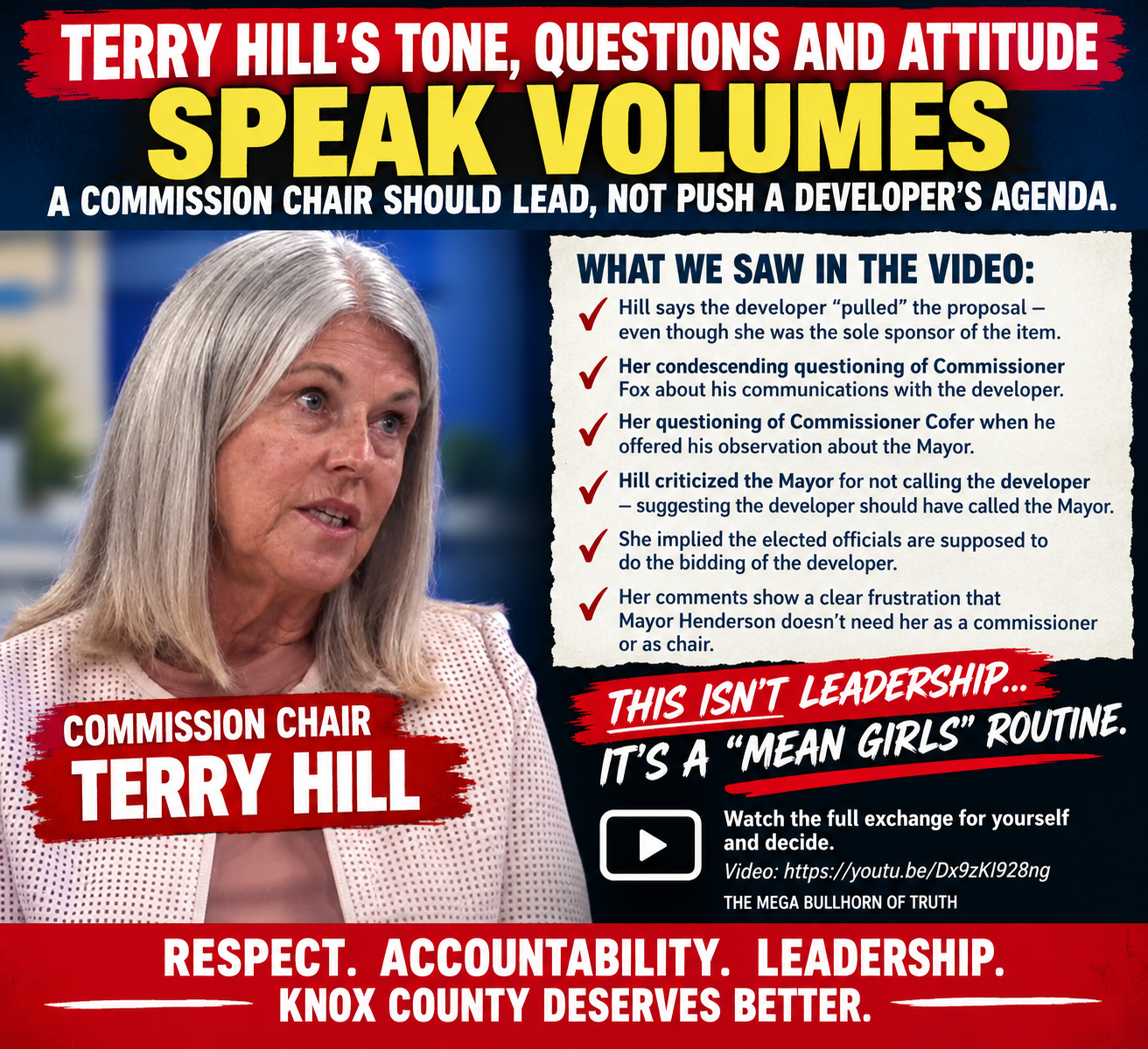
Knox County Commission Chair Terry Hill’s handling of Agenda Item No. 45 today at the Commission’s Optional Agenda Review for next Monday’s Commission meeting raises questions about how the chair views the roles of the Mayor, fellow commissioners, and a developer seeking approval for a project.
During the discussion, Hill expressed disappointment that the developer had withdrawn the proposal. She then questioned Commissioner Andy Fox about his communications with the developer and challenged Commissioner Justin Cofer after he offered his observations about Mayor Betsy Henderson’s veto.
The exchange is worth watching and hearing for yourself.
Watch the video and follow along with the transcript
Hill: “Since It’s Mine”
The exchange begins when Commissioner Angela Russell points out that Agenda Item No. 45 has no attachment and requests that it be removed from the consent calendar.
Hill immediately responds:
“I can go ahead and speak to 45 since it’s mine…”
That statement is important. Hill identifies the item as hers, then explains that the developer has chosen to withdraw the proposal.
Yet Hill’s subsequent comments focus heavily on the developer’s decision and Hill’s perception of the Mayor’s communication with the parties involved.
Hill says:
“I think that’s quite unfortunate that the decision was made so quickly…”
Hill goes on to suggest that if people had talked beforehand, and the developer had recognized the strength of the Mayor’s opposition, the developer would have withdrawn the proposal before the controversy generated what Hill calls “all of this newsprint.”
Hill then encourages more openness, transparency, and discussion between the Mayor’s Office and the parties directly involved in this veto.
There is certainly a legitimate question about communication between the Mayor’s Office, the Commission, and developers. But Hill’s remarks raise another question: Why is the Mayor being criticized for not having a conversation that the developer himself could have initiated?
If a developer wants to move a project forward and believes that the Mayor’s position is important to its future, why should the responsibility for initiating that conversation automatically fall on the Mayor?
Hill was the sponsor of the agenda item. That fact deserves to remain part of the discussion.
Commissioner Fox Responds: The Community’s Concerns Were Communicated
The district Commissioner Fox responds by explaining that he went to great lengths to communicate the community’s reaction to the project.
He specifically references the workshop held to bring those concerns to the developer’s attention.
Fox describes the developer’s responsiveness to community opposition as a unique experience, saying:
“I’ve certainly never had a developer be responsive to a community taking issue with a development.”
That is an important distinction in this exchange.
Fox is explaining that community concerns had already been communicated. Hill, meanwhile, is expressing disappointment that the developer withdrew the proposal and suggesting that more direct communication between the Mayor and the developer might have changed the course of events.
Those are two different perspectives on how the situation unfolded.
But the question remains: Why does Hill appear to place so much emphasis on what the Mayor should have done, rather than on her own role as the sponsor of item #45?
Hill’s Questioning of Commissioner Fox
Hill then turns her attention to Commissioner Fox.
She asks:
“Commissioner Fox, may I ask you outside of your workshop, did you sit down and talk with the developer?”
Fox explains that he had communicated his position to the developer and the developer’s representative, including at meetings and the workshop.
He states that he made clear both where he stood and where the community stood on the project.
Hill responds by clarifying that her statement was not about the community’s position, but rather about communication between the developer and the Mayor.
That clarification does not erase the substance of the exchange.
Fox had explained that the community’s opposition had been conveyed. Hill’s questioning shifts the focus to whether the Mayor had personally spoken with the developer.
To me, that is where the exchange becomes particularly troubling.
A commissioner is explaining his observations and the communications surrounding a project in his district. The chair’s questioning could reasonably be perceived as dismissive of that explanation, particularly when the conversation returns to what the Mayor should have done.
A chair has every right to ask questions. But the manner and purpose of those questions matter, too.
Commissioner Cofer Speaks Up
Commissioner Cofer then offers his observations, stating that the Mayor issued the veto because she listened to the people of Knox County.
He explains that Commissioner Fox opposed the project, that he had received calls and emails opposing it, and that he agreed with Fox’s position.
Cofer says:
“She did it because she listened to the people of Knox County.”
That is Cofer’s interpretation of the Mayor’s actions, and he makes it clear that he is speaking about what he observed.
Hill’s response?
“Commissioner Cofer, are you presuming to speak for our mayor?”
That question stands out.
Cofer had just prefaced his remarks by saying he was speaking about his observations. Hill’s question nevertheless challenges whether he is presuming to speak for the Mayor.
Cofer responds:
“Just speaking on my observations, Madame Chair…”
Hill then calls the matter a “mute point” and moves on.
The exchange is brief, but it illustrates the tension in the discussion: a commissioner offers his perspective, and the chair responds by questioning whether he is entitled to offer it in that way.
The Bigger Question: Who Is the Commission Working For?
This exchange raises a broader issue about the relationship between elected officials and developers.
Developers have every right to present proposals and pursue projects through the appropriate public process. Elected officials also have a responsibility to listen to residents, consider the concerns raised, and make decisions within their authority.
The Mayor is not required to agree with a developer simply because a project has been proposed. Commissioners are not required to support a project simply because it has been placed on an agenda.
And the Commission Chair’s responsibility is not simply to keep a project moving forward.
Hill’s remarks leave the impression that she believes more direct communication from the Mayor could have prevented the developer from withdrawing the proposal. But the transcript does not establish that the Mayor was responsible for the developer’s decision.
If the developer wanted to discuss the project with the Mayor, the developer could have requested that conversation.
That is why I question Hill’s emphasis on the Mayor’s failure to make that call.
The Political Tension Between Hill and Henderson
There is another dimension to this exchange that deserves attention.
Mayor Henderson has demonstrated that she is willing to exercise the authority of her office, including the veto power. Hill’s remarks about future vetoes and the need for the two offices to work well together suggest that the relationship between the Mayor’s Office and the Commission Chair may be a source of tension.
Hill says:
“I’m not real sure exactly how that works with us working well together the two offices…”
That comment, combined with her criticism of the Mayor’s communication, raises questions about how Hill views the working relationship between the two elected offices.
My impression is that Hill is having difficulty with a Mayor who does not need her to carry out the Mayor’s responsibilities.
That is my interpretation of the exchange, not something established by the transcript. But the public deserves to ask whether disagreements over policy are being handled through substantive discussion or becoming personal exchanges between elected officials.
The “Mean Girls” Routine Is Not Leadership
I have watched enough local government meetings to know that disagreements are part of the job. Commissioners can disagree with the Mayor. The Mayor can disagree with commissioners.
But there is a difference between asking tough questions and appearing to talk down to colleagues who are offering their observations.
Hill’s questioning of Fox and Cofer is the part of this exchange that deserves particular scrutiny. The tone and framing of those questions can be heard in the video, and viewers can make their own assessment.
My criticism is that this kind of exchange does little to build public confidence in the way elected officials work together.
The public expects commissioners to debate issues, explain their positions, and respect the role of other elected officials—even when they disagree.
Hill’s apparent frustration with the Mayor’s actions does not change that expectation.
Watch the Exchange for Yourself
I encourage readers to watch the full exchange and decide for themselves.
Video: The Commission’s discussion of Agenda Item No. 45
The transcript shows Hill identifying the item as hers, expressing disappointment over the developer’s withdrawal, questioning Commissioner Fox about communications, and challenging Commissioner Cofer’s observations about the Mayor.
My concern is that the discussion shifts attention away from the substance of the project and toward what the Mayor should have done to accommodate the developer.
The Mayor’s job is to represent the people of Knox County. The Commission Chair’s job is to lead the Commission’s deliberations. Neither position requires the Mayor to do a developer’s bidding.
And if Hill wants to criticize the Mayor’s handling of this matter, she should be prepared to explain why she believes the Mayor—not the developer—was responsible for initiating that conversation.
The public deserves that explanation.