

Frank Gibson, TCOG’s first executive director who had the idea to create an open government coalition in Tennessee, passed away the morning of May 17, 2026 in Florida. He is survived by his wife, Kathy; his daughter, Amy Sullivan, her husband David, and two grandchildren – Alexander Gibson and Keely Caroline.
I will send out more information later. There are plans for a Celebration of Life in Nashville.
HERE is a video about Frank produced for TCOG’s 20th Anniversary in 2023, Below is a story written by Jack McElroy for the event.
Published October 2023
By Jack McElroy
In the beginning, there was Frank. And Frank said:
LET THERE BE LIGHT!
Then the shadows of stealth and secrecy were driven from the halls of government all across the land. And the people saw that it was good.
Well … maybe TCOG’s origin wasn’t quite that simple. But it’s impossible to tell the story of the fight for open government in Tennessee without also telling the story of Frank Gibson.
It began in rural West Tennessee, where a good – but not great – football player on the Gleason High School team was writing about high-school happenings for the local newspaper and phoning in game scores to The Commercial Appeal in Memphis for $2 a game.
One night, a sportswriter from Nashville’s Tennessean showed up for a game, and after he was done interviewing the stars, Frank Gibson trotted over. How can I land a job at the newspaper? he asked. “Come see me when you’re in town,” the writer said.
Frank did and landed a job as a copy boy. On his first day of work in 1965, he got some sage advice: “If you show ‘em you will hustle, you will do OK.”
So Frank hustled. Soon he was a night police reporter.
John Seigenthaler, the legendary editor and publisher of the Tennessean, knew the teenager could do more, though. So he booted Frank off the paper and told him to come back with a college degree. Frank signed on for a stint with the Armed Forces Radio and Television Service then continued his education at the University of Tennessee, subsidized by the Tennessean and the GI Bill.
By 1970, he was editor of the Daily Beacon, the campus newspaper, which at the time had a circulation of 25,000.
After graduation, Frank continued at the Tennessean, earning a reputation as a shrewd and dogged reporter. Seigenthaler would later say that Frank was “better than anybody else I had ever known in tracking a paper trail” – including himself.
It was Frank’s understanding of the importance of public records that ignited his passion for government transparency.
Twenty years before TCOG was founded, he began his fight for open government.
At a national conference, Frank was elected regional director of the Society of Professional Journalists. During the victory party, delegates from Tennessee were grousing about how terrible the public records laws were back in their state. In those days, public officials could refuse to turn over a record, and if a journalist objected, it would take six months just to get a hearing.
Frank decided to attack the problem. He rounded up some interested folks from Knoxville and Memphis, and they drafted a bill to force quicker court hearings whenever records were denied. Frank then gave the bill to Sam Kennedy, chair of the Tennessee Press Association’s Government Affairs Committee, who got it passed.
Frank’s first open-government coalition was a success,
In 1987, an opportunity arose to broaden the coalition. Tennessee’s police chiefs were pushing legislation to close vital records to the public. Frank assembled representatives of the Commercial Appeal, the Tennessean and the state Broadcasters Association to come up with a plan to fight back.
They had an inside track. The governor at the time was Ned McWherter, a friend of Frank’s family. The group went to the Capitol and was granted a meeting with the governor almost immediately. McWherter listened as the journalists explained the situation.
The secrecy bill was quashed.
Frank then chaired Project Watchdog, SPJ’s $1 million campaign to educate the American
people on the importance of a free press. He ascended to SPJ’s national presidency and launched Project Sunshine, a nationwide grassroots effort aimed at maintaining open records and open meetings laws.
Frank’s day job was evolving, too. Seigenthaler made him metro editor. Then in 1992, Frank became the Tennessean’s political editor, which put him in charge of the reporters covering the state Capitol, giving him a close-up view of the legislature.
In1994, the Society of Professional Journalists brought its national convention to Nashville, and Frank served as convention chair. He also started going to national FOI conferences, gaining insight into the problems other state’s were having with government secrecy – and the solutions they were finding.
Soon he also was chairing the Tennessee Press Association’s Freedom of Information Committee, and, eventually, joint meetings of the organization’s FOI and Government Affairs committees.
He found himself fielding more and more calls from citizens across the state struggling with access issues.
A fresh challenge emerged with the start of the 21st century. A Chattanooga TV station sued to get photographs of police officers who had been suspended after the death of a prisoner they were transporting. A well-financed out-of-state police union stepped in and had the case moved into federal court, arguing that the officers’ privacy rights were threatened.
That terrified Frank, who feared a federal judge might declare Tennessee’s public records law unconstitutional. So he assembled a new coalition, this one of top First Amendment lawyers across the state: Alan Johnson, Doug Pearce, Rick Hollow, and Bud Jackson. They stepped into the case, had it removed from federal court, and ultimately won access to the photos.
It was the birth of what Frank began to call Tennessee’s open-government “brain trust.”
The case also showed the state’s need for a permanent body to fight for open government.
So Frank set out to create TCOG.
In February of 2003, Press Association President Ron Fryar agreed to chair a steering committee and Frank assembled a group of journalists and attorneys – and Dr. Dorothy Bowles of the University of Tennessee School of Journalism – to make plans.
In May, the National Freedom of Information Coalition held its annual conference in Nashville. Sixteen Tennesseans attended and came away excited, providing a core group for a Tennessee initiative.
Frank borrowed the non-profit structure that a buddy had used to set up a similar group in Virginia, and soon TCOG’s articles of incorporation had been filed with the state and a 401c3 application submitted to the IRS.
He opened a bank account, and Dorothy applied for a grant from UT. The $1,020 she landed became the first deposit. When the steering committee met in Knoxville in November 2003, TCOG was under way.
In early 2004, a website – tcog.info – was launched (tcog.org was unavailable, already taken by a South Korean Church of Christ). A board of directors replaced the steering committee. In addition to media representatives, seats were designated for Common Cause and the League of Women Voters.
Most importantly, Frank was hired to be TCOG’s executive director. He had struck a deal with Seigenthaler. The Tennessean would pay Frank 80 percent of his salary but require him to work just three days a week. The rest of his time would be dedicated to open government, with TCOG making up the rest of his salary.
The new group’s first order of business would be a statewide audit to test how effective – or ineffective – the state’s Public Records Act really was.
Over the next several months Frank and the new TCOG board recruited students, journalists and ordinary citizens across the state. Frank took a week of vacation to train the volunteers on the audit process.
In early November, 112 auditors descended on government offices in all 95 Tennessee counties. They made the same simple requests: Let us see the sheriff and police crime logs for the past 24 hours, the most recent minutes of the local zoning board, and the school district’s “zero tolerance” report.
The results were shocking. Although the records clearly were public under state law, government officials refused the auditors’s requests a third of the time. As one sheriff deputy ignorantly put it: “John Q. Citizen” can’t just walk in and see a public record.
Dorothy Bowles assembled and analyzed the data, and reporters from the state’s four largest newspapers turned the information into news stories that were published in every daily newspaper in the state that Thanksgiving week. Many newspapers followed up with vigorous editorials.
TCOG had made its presence known. Frank began fielding dozens of calls for advice, conducting training sessions, and lobbying against the secrecy bills that were always popping up in the legislature.
In 2005, he retired from the Tennessean, dedicating himself full-time to TCOG (even though he still was being paid as a part-time employee).
That same year, an unexpected opportunity arose. FBI and Tennessee Bureau of Investigation agents arrested several state legislators in a bribery sting dubbed Operation Tennessee Waltz. During the wave of reform that followed, Frank rushed in a plan to improve the state’s open-government laws. The proposal hit resistance during a special session, but lawmakers agreed to appoint an interim study committee. Frank made sure the committee was loaded with open-government advocates.
The study took two years. Local politicians wanted to make changes to the Sunshine Law, which governed public meetings, to allow more secrecy. So Frank worked with Sen. Randy McNally to address only the Public Records Act. The resulting bill, which Frank maneuvered through the legislature in 2008, forced local governments to be much more responsive when citizens asked to see records.
Then Gov. Phil Bredesen took the reforms a step further. Working with Frank, he created the Office of the Open Records Counsel, an ombudsman who could help enforce the new, tougher transparency law. Elisha Hodge was named the state’s first open-records counsel. For the first time, an umpire was calling balls and strikes when Tennesseans wanted to find out what their government was doing.
In the years that followed, Frank continued to lead TCOG as its reputation grew. He fielded more than 200 inquiries a year from journalists and citizens needing help, fought countless battles before the legislature, wrote dozens of columns and op-eds, and conducted formal and informal training sessions across the state.
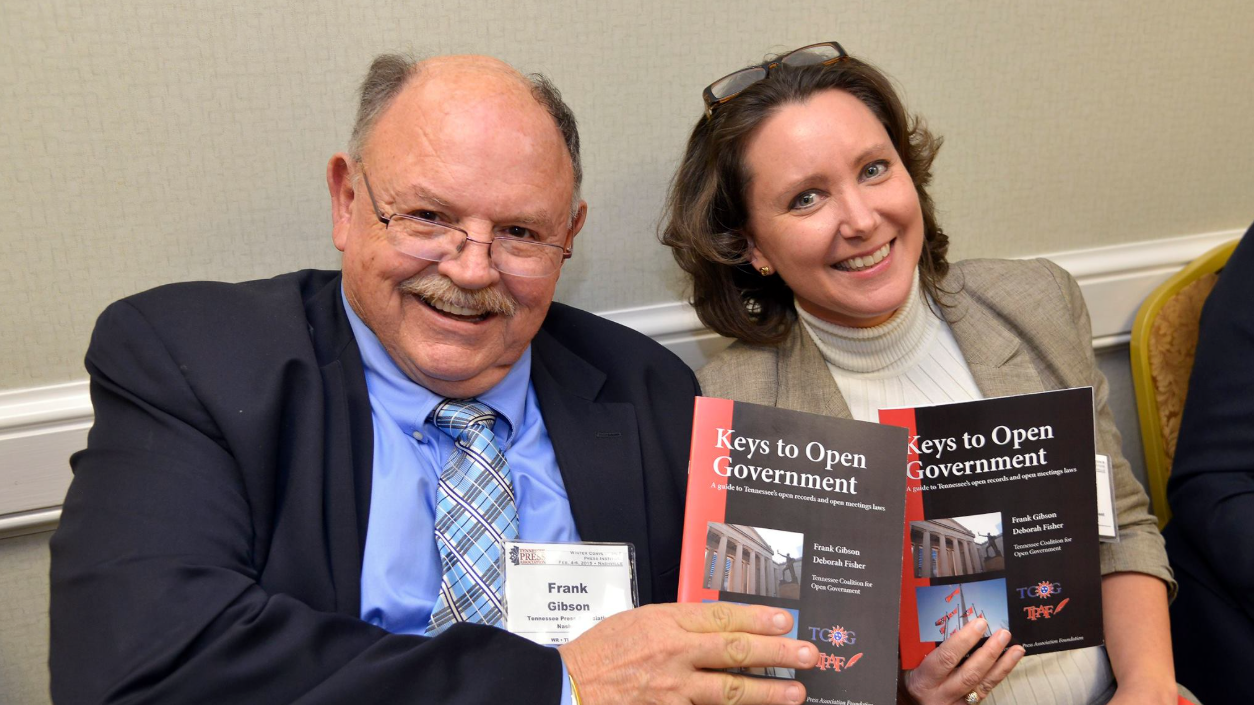
In 2013, the Tennessee Press Association recruited Frank to be its public policy director, and Deborah Fisher was hired as TCOG’s executive director. The two made a powerful team. Frank authored, and Deborah edited, “Keys to Open Government,” a citizen’s guide to the records and open meetings laws. It was published in 2015 with a grant from the Tennessee Press Association Foundation.
TCOG’S impact on the public’s consciousness was apparent by September 2015, when hearings were held across the state on a proposal to let local governments start charging citizens just to look at public records. Scores of Tennesseans spoke up at the meetings and hundreds commented online or in writing. Their loud-and-clear objections forced the legislature to abandon the proposal.
Frank’s credibility among public officials was evident, as well, when, in 2016 scandal again rocked the legislature, this time involving sexual harassment, Speaker of the House Beth Harwell recruited him to serve on a task force to revamp the General Assembly’s sexual harassment policy.
Frank retired as TPA’s public policy director in 2017. The following year he was inducted into the Tennessee Journalism Hall of Fame, and in 2019 he was named the University of Tennessee journalism alumnus of the year. He also has been awarded the Wells Memorial Key, the highest honor bestowed by the Society of Professional Journalists.
He now lives with lifelong partner Kathy Ann Gibson in Land o Lakes, Florida, where they are close to their daughter Amy Sullivan, her husband David, and two grandchildren – Alexander Gibson and Keely Caroline.
Of course, Frank continues to serve actively on the TCOG board, too, still providing invaluable advice whenever asked – which is often.