


The Mega Bullhorn of Truth | a Brian Hornback Production
Real News – Local Voices – East Tennessee Valley to the World Wide Web – TRUTH.
Knox County taxpayers deserve to know how their money is being spent, how county offices are staffed, how salaries change over time, and whether the offices responsible for oversight have the resources, independence, and accountability necessary to do their jobs.
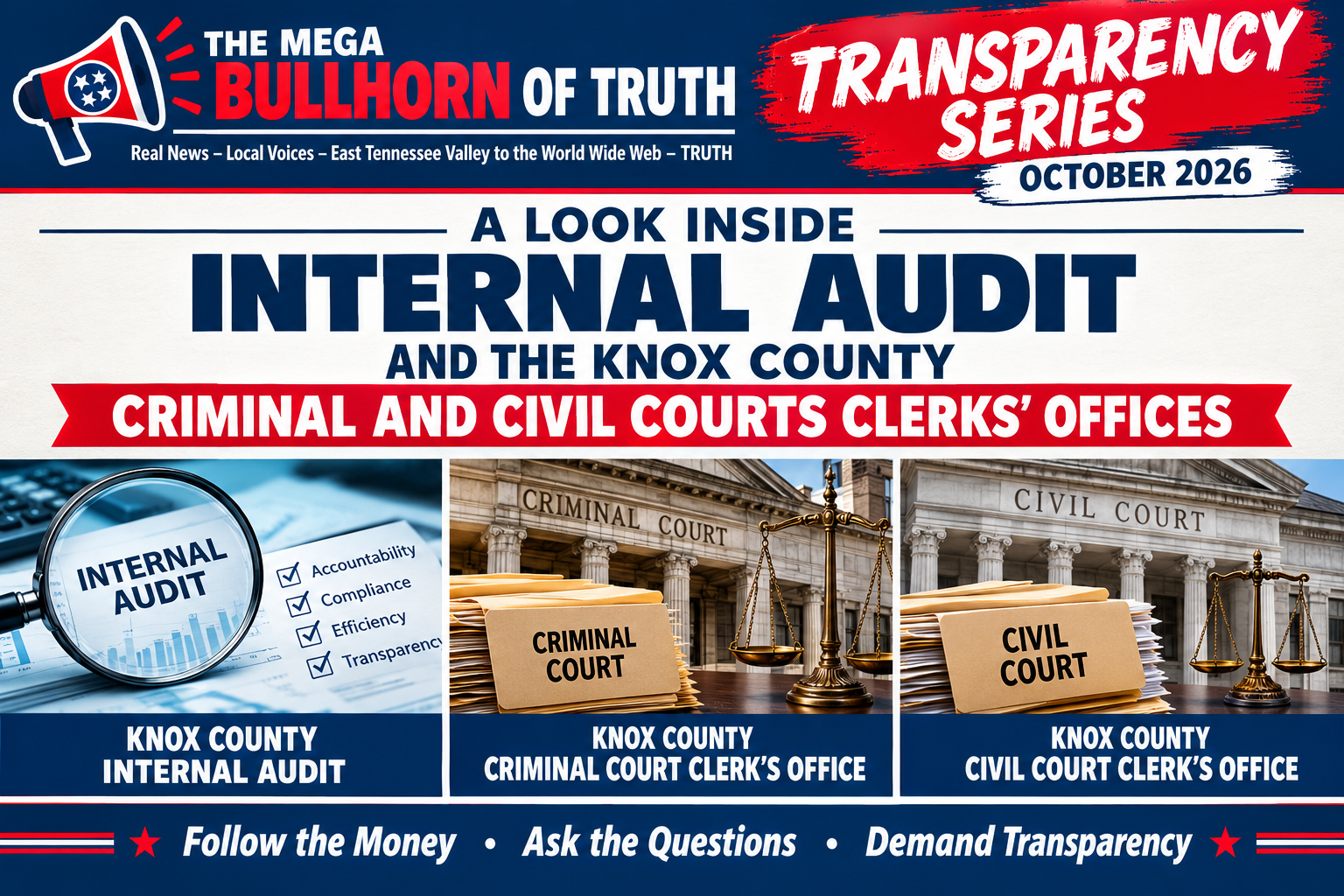
For October 2026, The Mega Bullhorn of Truth continues its Transparency Series with a look inside three important county government operations: Knox County Internal Audit, the Criminal Court Clerk’s Office, and the Civil Court Clerk’s Office.
This report examines salary information dated April 28, 2022, and April 29, 2026, for Internal Audit, along with the 2026 salary figures supplied for the two court clerk operations. It also raises questions about salary increases, vacant positions, oversight, and the need for clear answers from county government.
Let me make one thing clear: publishing a salary does not establish wrongdoing. Public employees perform important work, and the public has a legitimate interest in understanding how tax dollars support that work. The purpose of this series is to put the available numbers in front of the taxpayers and ask questions that deserve documented answers.
Part One: Knox County Internal Audit
A look back at April 28, 2022
The salary information for April 28, 2022, identifies Andrea Addis as the County Internal Auditor. Addis left the position in the summer of 2023.
The supplied roster lists the following positions and annual salary figures:
| Position | Annual salary |
|---|---|
| Administrative Assistant — vacant | $21,216.00 |
| Information Technology Auditor — vacant | $87,785.10 |
| Auditor III — vacant | $72,186.14 |
| Part-time Intern — vacant | $1,200.00 |
| County Internal Auditor | $134,442.10 |
| Audit Manager | $105,375.40 |
| Auditor II | $61,740.07 |
| Auditor II | $60,194.33 |
| Auditor I | $47,687.00 |
This roster reflects a department with multiple vacancies, including positions dedicated to information technology auditing and audit staff support.
Those vacancies are worth noting because Internal Audit should be an important component of public accountability. Its work can help identify weaknesses in internal controls, procedures, financial practices, and compliance. The public interest is not simply how much the office spends, but whether it has the staffing and resources needed to perform its responsibilities effectively.
The April 29, 2026, roster
Four years later, the supplied salary information shows a different staffing structure:
| Position | Annual salary |
|---|---|
| County Internal Auditor | $165,170.20 |
| Lead Auditor | $106,841.02 |
| Staff Auditor | $66,645.02 |
| Staff Auditor | $65,985.66 |
| Staff Auditor | $66,645.02 |
| Part-time Intern — vacant | $1,200.00 |
The most notable comparison is the County Internal Auditor position.
- April 28, 2022: $134,442.10
- April 29, 2026: $165,170.20
- Dollar increase: $30,728.10
- Percentage increase: approximately 22.86%
The salary rose by more than $30,000 between the two reported dates. The 22.86% figure is the calculated increase based on the two salaries listed above.
That is a substantial change worth examining. But a fair comparison must account for the exact dates, any changes in job classification, compensation adjustments, and whether the figures represent the same position and salary basis throughout the period.
The question of annual increases
My concern is not that an auditor should never receive a salary increase. The question is how this increase occurred, when the adjustments were made, and how they compare with the compensation decisions affecting other Knox County employees.
The supplied figures show a 22.86% increase over the four-year comparison period. They do not, by themselves, establish that the employee received an 10.83% increase in each of two consecutive years. That conclusion requires the individual salary history and the effective dates of each adjustment.
Those are precisely the records taxpayers should be able to examine.
On July 1, 2026, Knox County employees received a reported 6% pay increase. The county’s adopted budget, the applicable personnel records, and the actual payroll history are the appropriate sources for confirming how that increase was applied to the Director of Internal Audit.
If the Director’s salary of $165,170.20 received an additional 6% increase, the calculation would be:
- Additional annual compensation: $9,910.21
- Resulting annual salary: $175,080.41
These are mathematical estimates based on the supplied salary and a hypothetical 6% increase, not confirmation of the Director’s actual current salary. An open-records request can establish whether that increase was applied, whether other adjustments occurred, and what salary was in effect after July 1, 2026.
Taxpayers deserve the actual records, not assumptions.
Part Two: Who is leading Internal Audit?
The supplied professional history for Director of Internal Audit Fullerton provides a timeline that helps readers understand his professional background.
According to the LinkedIn profile information provided for this report, the timeline includes:
- April–August 2014: Legal Intern, U.S. Department of the Interior, Office of the Solicitor.
- June 2015–September 2016: Research Assistant to Tennessee State Representative Martin Daniel, who later became chairman of the Knox County Republican Party.
- April–September 2016: Paralegal at the Law Office of Daniel Kidd.
- September 2016–August 2017: Investigator with the State of Tennessee.
- August 2017–November 2019: Internal Auditor II, Knox County
- November 2019–November 2021: Internal Auditor III, Knox County
- November 2021–October 2022: Senior Internal Auditor at Oak Ridge National Laboratory.
- October 2022–September 2023: IT Compliance Director for Knox County.
- September 2023–present, according to the public profile: Director of Internal Audit, Knox County
The Daniel Kidd connection
The supplied timeline also identifies Fullerton’s work as a paralegal for Daniel Kidd in 2016.
Kidd was the Democratic candidate for Knox County Fourth Circuit Court Judge, Division IV, in the 2014 general election against Republican Greg McMillan. The figures supplied for that election are:
- Greg McMillan: 39,389 votes, approximately 72.85%.
- Daniel Kidd: 14,678 votes, approximately 27.15%.
This is historical background about a former professional association. The fact that someone worked for a lawyer who later ran for judicial office does not, by itself, establish a conflict of interest or improper conduct. Any claim of a conflict would require specific evidence about a matter, relationship, or decision that created one.
The public is entitled to understand the professional backgrounds of officials entrusted with oversight. At the same time, those backgrounds should be presented accurately and in context.
Internal Audit and the questions surrounding other county investigations
There is another issue that deserves attention: how Internal Audit operates in relation to other county departments and investigations conducted by outside agencies.
During a recent court hearing involving Property Assessor Phil Ballard, his criminal defense attorney, T. Scott Jones, questioned an investigator with the Tennessee Office of the Comptroller about whether the conclusion of an investigation by the referring agency necessarily concluded the broader matter. The Investigator said in open court, that it was not necessary for the investigation by the Comptroller’s Investigative Unit..
The larger question is legitimate: When a county department identifies a potential problem, what happens next, who is responsible for following up, and how is the public informed about the outcome?
An investigation can involve different agencies, different legal responsibilities, and separate processes. The conclusion of one agency’s work does not necessarily establish that every related matter has ended. Conversely, it does not establish that misconduct occurred.
That is why clear records, defined responsibilities, and transparent reporting matter.
Previous questions involving county equipment and oversight
There have been public reports and allegations involving county equipment and employee practices that make the subject of internal controls especially important.
In September 2024, Knox News reported on a stolen laptop that led to an investigation involving the Knox County Property Assessor’s Office. The report is available here:
Knox News: Stolen laptop led to investigation of Knox County Property Assessor’s Office
A separate Knox News report from May 2019 covered claims by former county staff members who said whistleblowing led to their termination, in a matter that included computers purchased in 2018 and received in and by a fee office:
Knox News: Former Knox County staffers claim whistleblowing led to firing
The supplied materials also reference a claim that an employee worked remotely from outside Tennessee for approximately two years.
These are separate matters, occurring at different times and involving different circumstances. They should not be treated as proof of wrongdoing by the current Internal Audit director. They do, however, illustrate why policies for purchasing equipment, tracking county property, supervising employees, and responding to allegations should be documented and consistently followed. The records from Internal Audit are not publicly available, only controlled by county employees and few elected officials.
The question for Knox County Mayor Betsy Henderson and the Knox County Commission is straightforward: Are the controls in place, are they working, and can the county demonstrate that they are working?
Part Three: The Knox County Criminal Court Clerk’s Office
Now let’s turn to the salaries reported for the Knox County Criminal Court Clerk’s Office as of April 29, 2026.
The supplied figures list the Criminal Court Clerk’s annual salary at $186,834.44. The roster also includes deputy clerks assigned to Criminal Court, Fourth Circuit, and Criminal Sessions.
Rather than burying readers in dozens of individual salary entries without context, let’s look at the structure and the questions those numbers raise.
Deputy Clerks — Criminal
The supplied roster contains 26 salary entries under the Deputy Clerk’s Criminal category. The amounts range from approximately $9,999.86 to $140,400.00.
The list includes several salaries around $50,000–$72,000, others approaching or exceeding $100,000, and a few substantially lower amounts.
A salary roster is a snapshot, however. A figure substantially below a full-year salary could reflect part-time employment, a partial year of service, a recent hire, a vacancy, or another payroll circumstance. The roster alone does not establish which explanation applies.
Deputy Clerks — Fourth Circuit
The supplied Fourth Circuit category contains 13 salary entries, ranging from $10,799.88 to $79,999.92.
These figures raise a practical question: Are the differences explained by job classifications, years of service, hours worked, or other documented factors?
Taxpayers should be able to understand the compensation structure without having to guess why two employees working in the same general court system may receive substantially different amounts.
Deputy Clerks — Criminal Sessions
The largest category in the supplied Criminal Court roster is Deputy Clerk, Criminal Sessions. It contains 43 salary entries, with figures ranging from $18,720.00 to $114,999.82.
The range is wide. That does not automatically indicate a problem. Different responsibilities, experience, hours, and employment dates may explain some of the variation.
But it is reasonable to ask whether Knox County maintains clear, consistent job classifications and compensation policies—and whether those policies are available for public review.
The public should also be able to distinguish between an employee’s annualized salary rate and the actual compensation paid during a particular year. Those are not always the same thing.
Part Four: The Knox County Civil Court Clerk’s Office
The supplied April 29, 2026, figures list the Civil Court Clerk’s annual salary at $186,834.44, the same amount listed for the Criminal Court Clerk.
The Civil Court Clerk’s roster includes employees serving Sessions Court, Circuit Court, Juvenile Court, and related administrative functions.
The figures below are the amounts supplied for this report. They should be understood as salary entries, not necessarily confirmed full-year earnings.
Sessions and Circuit Court
The roster includes several job classifications, including Deputy Clerk 1, Deputy Clerk 2, Deputy Clerk 3, Deputy Clerk 4, and Deputy Clerk 5.
The supplied entries include:
- Deputy Clerk 1: $102,477.44
- Deputy Clerk 2: $71,820.08, $86,264.00, $93,728.96, and $79,384.50
- Deputy Clerk 3: $75,000.00, $77,828.14, and entries marked vacant
- Deputy Clerk 4: figures ranging from $55,080.22 to $58,809.14
- Deputy Clerk 5: numerous entries, including several at or near $55,000, alongside lower salary amounts and positions marked vacant
Several positions were marked vacant on April 29, 2026. Those notations describe the information available on that date; they do not establish whether a position remains vacant today.
A salary entry marked vacant should not be interpreted as money actually paid to an employee. Nor should a vacancy be assumed to remain unfilled months after the roster date. Updated staffing records would answer that question.
Juvenile Court
The supplied Juvenile Court section includes a supervisor, deputy clerks, courtroom clerks, a minute courtroom clerk, bookkeeping positions, a legal secretary, a systems administrator, a special projects coordinator, an appellate clerk, a temporary part-time position, and a jury coordinator.
Some of the reported salaries include:
| Position | Reported annual salary |
|---|---|
| Supervisor, Juvenile Court | $57,128.24 |
| Additional supervisor-level entry | $74,735.44 |
| Systems Administrator | $101,417.68 |
| Special Projects Coordinator | $75,810.28 |
| Appellate Clerk | $71,538.74 |
| Legal Secretary | $52,239.46 |
| Jury Coordinator | $38,161.24 |
| Temporary Part-Time — vacant | $25,740.00 |
The deputy clerk and courtroom clerk entries vary, with many reported salaries falling between approximately $38,000 and $49,000.
The systems administrator’s reported salary is notably higher than many of the courtroom clerk entries. That difference alone does not establish an inequity; the jobs involve different duties and qualifications.
What matters is whether job classifications, responsibilities, and pay ranges are clearly established and applied consistently.
Administrative and operational questions
The Civil Court Clerk’s roster also includes a chief bookkeeper at $39,631.80 and bookkeeper entries at $38,612.86, $51,528.88, and $53,090.44.
The temporary part-time position is listed as vacant, with a reported salary figure of $25,740.
These entries illustrate why salary transparency requires more than a list of numbers. Readers need to know which amounts represent authorized salary rates, which reflect actual payroll expenditures, which positions were vacant, and whether the amounts include any supplemental compensation.
A complete public accounting should make those distinctions clear.
Part Five: What should taxpayers be asking?
Across Internal Audit and the two court clerk operations, several questions deserve documented answers.
1. How are salary increases approved?
What policies govern annual increases, promotions, classification changes, and adjustments outside the general county pay plan? Are exceptions documented and available for review?
2. What was the actual salary history of the Director of Internal Audit?
The reported figures show an increase from $134,442.10 in April 2022 to $165,170.20 in April 2026. What adjustments occurred between those dates, and when did each take effect?
3. How was the July 2026 pay increase applied?
Did the Director of Internal Audit receive the reported 6% increase? Were other adjustments made? The actual payroll and personnel records should settle the question.
4. What is the status of positions marked vacant?
Which positions have since been filled? How long were they vacant? What were the resulting salary savings, and how were the positions funded?
5. Are the Criminal and Civil Court Clerk salary structures documented?
What are the authorized salary ranges for each deputy clerk classification? What factors explain differences within a classification?
6. How does Internal Audit follow up on identified weaknesses?
What procedures determine whether corrective actions are completed? How are unresolved findings reported to county leadership, and what information is available to the public?
7. Are purchasing, equipment, and employee policies consistently enforced?
The county should be able to explain its controls for purchasing technology, tracking equipment, authorizing remote work, and investigating reported violations.
These are not accusations. They are questions about the operation of local government and the use of public money.
Part Six: Open records and the next step
I intend to seek additional records to establish the facts that the supplied salary snapshots cannot answer.
Those records should include:
- The Director of Internal Audit’s salary history, with each adjustment and its effective date.
- The applicable July 1, 2026, pay adjustment and any other compensation changes.
- Relevant Internal Audit reports, findings, and corrective-action tracking records, subject to applicable disclosure laws.
- Applicable policies governing county equipment purchases, equipment inventories, remote work, and employee oversight.
The goal is to distinguish the original salary figures from actual payroll expenditures, and confirmed facts from unanswered questions.
Where a record supports a conclusion, the public deserves to see that conclusion explained. Where a record does not support an allegation, that distinction matters just as much.
The Mega Bullhorn of Truth’s bottom line
Knox County government handles substantial amounts of public money. The people who fund county government through their taxes have every right to ask how that money is spent, how employees are compensated, and whether the safeguards intended to protect the public are working.
Internal Audit has an especially important role in that process. Its responsibilities make transparency, independence, sound internal controls, and documented follow-through essential.
The Criminal and Civil Court Clerk’s offices also perform critical public functions. Their employees deserve fair and consistent compensation, and taxpayers deserve understandable records showing how those compensation decisions are made.
The salary figures presented in this October 2026 installment are a starting point—not proof of wrongdoing. The comparisons identify matters that warrant further documentation, particularly the Internal Audit director’s salary history and the distinction between reported salary rates and actual payroll.
Transparency is not about presuming guilt. It is about making government accountable to the people who pay for it.
This is The Mega Bullhorn of Truth | a Brian Hornback Production
Follow the Money. Ask the Questions. Demand Transparency.
Real News – Local Voices – East Tennessee Valley to the World Wide Web – TRUTH.